
Breastfeeding and GLP-1 Medications
Why IBCLCs Are Suddenly Getting So Many Questions About Ozempic and Breastfeeding?
1. GLP-1 medications are being prescribed more than ever
2. Postpartum parents are often thinking about weight and metabolic health
3. There is still limited research on medications during lactation
4. More awareness of metabolic health and milk supply
5. Parents want to continue breastfeeding if possible
GLP-1 Medications and Breastfeeding: What Nursing Parents Need to Know
Weight-loss medications like semaglutide (Ozempic®, Wegovy®, Rybelsus®) and tirzepatide (Mounjaro®, Zepbound®) have become increasingly common. As their use grows, many breastfeeding parents are asking an important question:
Can you take GLP-1 medications while breastfeeding?
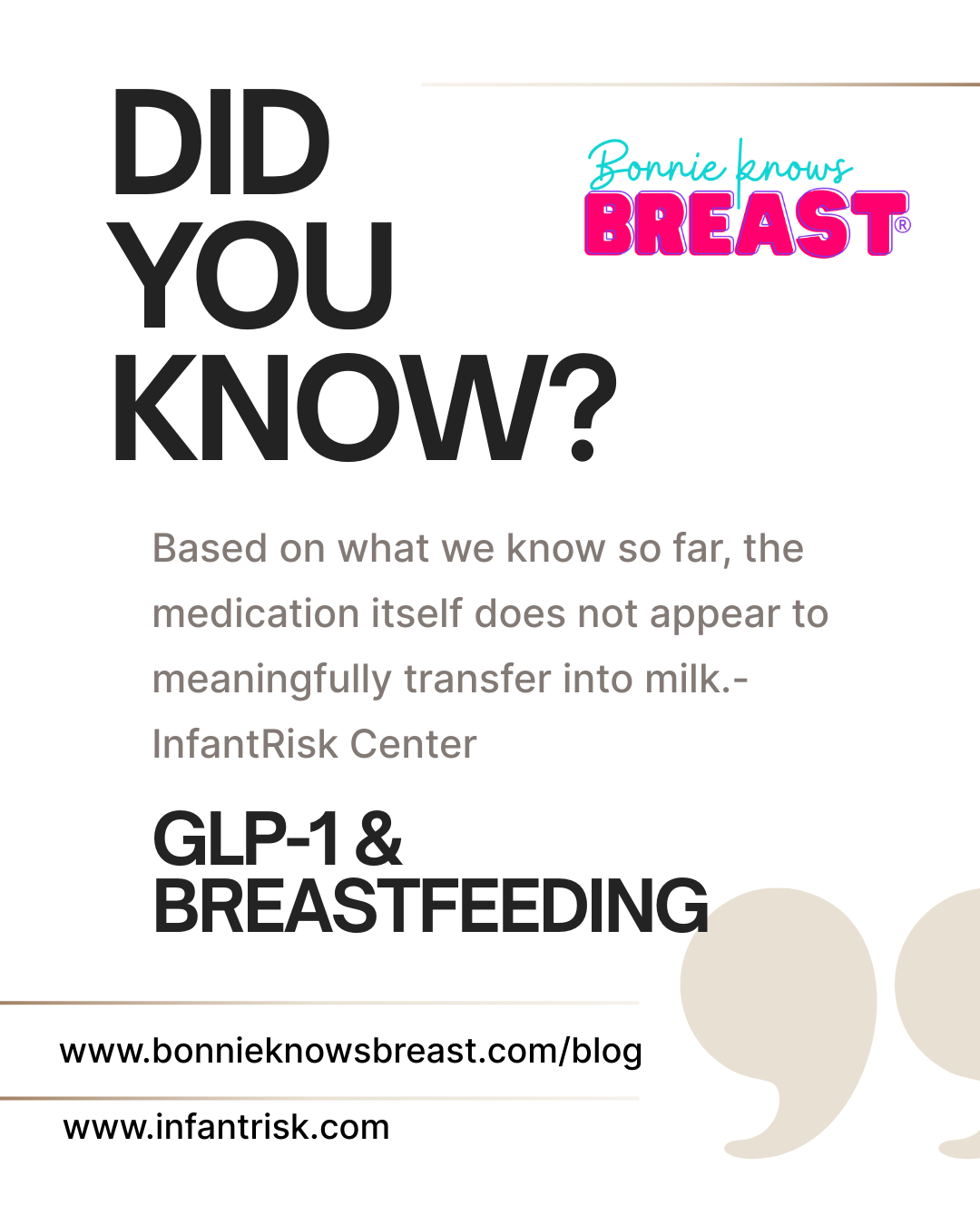
Emerging research — including new guidance from the InfantRisk Center — suggests that the biggest concern during breastfeeding may not be medication transfer into breast milk, but whether the parent is able to consume enough calories and nutrients to support milk production.
Here’s what we know so far.
Quick Answer: Can You Take GLP-1 Medications While Breastfeeding?
Current evidence suggests that tirzepatide is unlikely to transfer into breast milk in meaningful amounts. Early studies have found the medication to be either undetectable or present in extremely small amounts in breast milk, with no reported side effects in infants.
However, GLP-1 medications significantly reduce appetite, which may make it harder for breastfeeding parents to consume enough calories, fluids, and nutrients needed for milk production.
Because of this, the primary concern during breastfeeding is nutritional intake rather than drug exposure through milk.
Do GLP-1 Medications Pass Into Breast Milk?
Early research is reassuring.
A study conducted by the InfantRisk Center found that tirzepatide was either undetectable or present in extremely small amounts in breast milk at doses up to 5 mg, and no adverse effects were observed in the infants involved in the study.
This finding is biologically plausible. Tirzepatide is a large protein molecule, and large protein molecules generally do not pass easily into breast milk.
Even if small amounts did enter milk, they would likely be broken down in the infant’s digestive tract, just like other proteins naturally present in breast milk.
Based on what we know today, clinically significant exposure through breast milk appears unlikely.
The Bigger Concern: Appetite Suppression During Lactation
While medication transfer appears minimal, GLP-1 medications are designed to reduce appetite and slow digestion.
Studies show that people taking these medications may reduce their calorie intake by up to 39%.
That matters because breastfeeding requires substantial energy and nutrient intake.
Breastfeeding parents typically need:
About 2,000 calories per day for baseline metabolism
An additional ~250 calories or more for milk production
If appetite suppression leads to inadequate calorie intake, this can result in:
Reduced milk supply
Dehydration
Fatigue or dizziness
Nutrient deficiencies
Potential changes in breast milk nutrient composition
In other words, the primary concern during breastfeeding is maintaining adequate nutrition — not medication exposure in milk.
Could GLP-1 Medications Ever Improve Milk Supply?
For some parents, the relationship between metabolic health and milk production is complex.
One factor that is increasingly recognized in lactation science is insulin resistance. Insulin plays an important role in the mammary gland’s ability to respond to prolactin, the hormone responsible for stimulating milk production.
When insulin resistance is present — which is common in conditions such as obesity, PCOS, prediabetes, and type 2 diabetes — the breast may not respond as effectively to prolactin signals. This can interfere with establishing or maintaining milk supply.
Medications like tirzepatide and semaglutide improve insulin sensitivity and reduce chronic inflammation. In theory, improving metabolic health may help restore more normal hormonal signaling involved in lactation.
This means that addressing untreated insulin resistance could potentially support milk production in some individuals by improving the body’s response to prolactin.
However, there is an important timing issue.
Appetite suppression occurs immediately after starting the medication, while metabolic improvements such as improved insulin sensitivity often take weeks to months.
Because the first two weeks postpartum are a critical period for establishing milk supply, reduced calorie intake during this time could still negatively affect lactation.
At this time, more research is needed to understand how GLP-1 medications may affect milk supply long term.
When Is It Safer to Start GLP-1 Medications While Breastfeeding?
Timing may influence risk.
During the first six months of life, breast milk is typically the baby’s primary or sole source of nutrition if exclusively breastfeeding.
If maternal calorie intake drops significantly during this time, there is no nutritional backup for the infant.
Once babies begin eating complementary foods around six months, their nutrition gradually becomes more diversified.
For this reason, some experts suggest that if there is flexibility, waiting until at least 7–12 months postpartum may be a more conservative approach.
However, if a medication is needed for medical reasons such as diabetes management, the benefits may outweigh potential concerns. Decisions about medication use during breastfeeding should always be made with a healthcare provider.
How to Protect Milk Supply While Taking GLP-1 Medications
If you and your healthcare provider decide that a GLP-1 medication is appropriate during breastfeeding, nutrition becomes especially important.
Helpful strategies include:
Eat small, frequent meals
Even if hunger cues are reduced, try to eat regularly throughout the day.
Prioritize protein
Include protein with every meal or snack.
Choose nutrient-dense foods
Examples include:
Eggs
Fish or chicken
Beans and lentils
Whole grains
Fruits and vegetables
Nuts and seeds
Healthy fats
Stay hydrated
Aim for 2–3 liters of fluid per day, especially if experiencing nausea or digestive side effects.
Consider a prenatal or multivitamin
Breastfeeding parents may need additional iron, calcium, magnesium, folate, and vitamin D.
Monitor your baby
Watch for:
Normal weight gain
Adequate wet diapers
Typical feeding behavior
Your pediatrician should be aware of any medications you are taking while breastfeeding.
Avoid Rapid Weight Loss While Breastfeeding
Very rapid weight loss during lactation can increase the risk of:
Reduced milk supply
Fatigue
Gallstones
A slow and gradual weight loss of about 1 pound per week is generally considered safer during breastfeeding.
Important Birth Control Consideration
Tirzepatide slows digestion and may reduce the effectiveness of oral contraceptive pills. If you are taking oral birth control, discuss alternative contraception options with your healthcare provider.
The Bottom Line
Current evidence suggests that tirzepatide is unlikely to transfer into breast milk in meaningful amounts.
The larger concern during breastfeeding is maintaining adequate calorie, nutrient, and fluid intake while appetite is suppressed.
For parents exclusively breastfeeding a newborn, appetite suppression may make meeting nutritional needs more challenging. For those occasionally nursing an older baby or toddler, the overall risk may be much lower.
With thoughtful nutrition, monitoring, and collaboration with healthcare providers, some parents may be able to continue breastfeeding while using GLP-1 medications.
Frequently Asked Questions About Breastfeeding and GLP 1-s:
Can you take Ozempic while breastfeeding?
Research on semaglutide (Ozempic®, Wegovy®) during breastfeeding is limited. However, based on the medication’s large molecular size, significant transfer into breast milk is considered unlikely. The bigger concern is maintaining adequate nutrition and milk supply.
Do GLP-1 medications reduce milk supply?
They may. Because these medications suppress appetite, reduced calorie intake may lead to decreased milk production if nutritional needs are not met.
Can GLP-1 medications help milk supply?
Possibly in some cases. By improving insulin resistance, these medications may improve the body’s response to prolactin. However, this potential benefit has not yet been well studied.
Can insulin resistance or GLP-1 medications affect breast milk supply?
Find out more in this blog post on insulin resistance.
References
InfantRisk Center.
Emerging data on tirzepatide transfer into human milk (study under review).
Diab H, Fuquay T, Datta P, Bickel U, Thompson J, Krutsch K. Subcutaneous Semaglutideduring Breastfeeding: Infant Safety Regarding Drug Transfer into Human Milk. Nutrients. 2024 Aug 28;16(17):2886. doi: 10.3390/nu16172886. PMID: 39275201; PMCID: PMC11397063.
Heise T, DeVries JH, Urva S, Li J, Pratt EJ, Thomas MK, Mather KJ, Karanikas CA, Dunn J, Haupt A, Milicevic Z, Coskun T. Tirzepatide Reduces Appetite, Energy Intake, and Fat Mass in People With Type 2 Diabetes. Diabetes Care. 2023 May 1;46(5):998-1004. doi: 10.2337/dc22-1710. PMID: 36857477; PMCID: PMC10154650.
Baxter, J. B., Wasan, Y., Daniel, A. I., Begum, K., Hussain, A., Iqbal, J., Aufreiter, S., Beggs, M. R., Duan, L., Greco, A., Huang, C., Soofi, S., Bandsma, R. H., Bhutta, Z. A., & O'Connor, D. L. (2025). Maternal multiple micronutrient supplementation in rural Pakistan increased some milk micronutrient concentrations, but not infant growth, at three-months postpartum: a randomized controlled trial substudy. Am J Clin Nutr, 122(1), 174-184. https://doi.org/10.1016/j.ajcnut.2025.05.019
Mozaffarian, D., Agarwal, M., Aggarwal, M., Alexander, L., Apovian, C. M., Bindlish, S., Bonnet, J., Butsch, W. S., Christensen, S., Gianos, E., Gulati, M., Gupta, A., Horn, D., Kane, R. M., Saluja, J., Sannidhi, D., Stanford, F. C., & Callahan, E. A. (2025). Nutritional priorities to support GLP-1 therapy for obesity: a joint Advisory from the American College of Lifestyle Medicine, the American Society for Nutrition, the Obesity Medicine Association, and The Obesity Society. The American Journal of Clinical Nutrition, 122(1), 344-367. https://doi.org/https://doi.org/10.1016/j.ajcnut.2025.04.023
Nommsen-Rivers LA. Does insulin explain the relation between maternal obesity and poor lactation outcomes? Adv Nutr. 2016;7(2):407-414.
Nommsen-Rivers LA, Chantry CJ, Peerson JM, Cohen RJ, Dewey KG. Delayed onset of lactation among first-time mothers is related to maternal obesity and factors associated with ineffective breastfeeding. Am J Clin Nutr. 2010;92(3):574-584
Jarlenski MP, Bennett WL, Bleich SN, Barry CL, Stuart EA. Effects of breastfeeding on postpartum weight loss among U.S. women. Prev Med. 2014/12/01/ 2014;69:146–150. doi:10.1016/j.ypmed.2014.09.018
Stuebe A. Associations Among Lactation, Maternal Carbohydrate Metabolism, and Cardiovascular Health. Clin Obstet Gynecol. Dec 2015;58(4):827-39. doi:10.1097/grf.0000000000000155
Creasy SA, Lang W, Tate DF, Davis KK, Jakicic JM. Pattern of Daily Steps is Associated with Weight Loss: Secondary Analysis from the Step-Up Randomized Trial. Obesity (Silver Spring). Jun 2018;26(6):977-984. doi:10.1002/oby.22171
Singh G, Krauthamer M, Bjalme-Evans M. Wegovy (semaglutide): a new weight loss drug for chronic weight management. J Investig Med. Jan 2022;70(1):5-13. doi:10.1136/jim-2021-001952